
I hit a wall in college.
I was not in some dramatic crisis. I had not walked away from faith or done something catastrophic. I had simply stopped growing. My prayer life had become mechanical. My Bible reading had become inconsistent. Church felt like an obligation rather than something I genuinely looked forward to.
I remember sitting in my car one morning before school, feeling spiritually empty, and thinking — is this all there is?
I had started so strong. The early days of my faith were full of excitement, hunger, and a sense of God’s presence that felt almost tangible. But somewhere along the way, without me even noticing, I had drifted.
I had not walked away from God.
Looking back, I don’t think I drifted all at once. I drifted one neglected day at a time.
That season taught me one of the most important lessons of my spiritual life — faith does not maintain itself. It has to be fed. It has to be exercised. It has to be tended to with the same kind of intentionality we give to anything in life that we want to keep strong.
That is what this chapter is about.
Not adding more religious activity to your already full life.
But building the kind of consistent, sustainable habits that keep your relationship with God alive, growing, and deeply personal for the rest of your life.
Spiritual Disciplines Are Not About Earning — They Are About Growing
Before we go any further, I want to address something that trips a lot of believers up.
Spiritual disciplines are not ways to earn God’s love or approval.
Remember what we talked about in Chapter 5 — you are already fully accepted by God through Jesus Christ. Your standing with Him is not based on how many chapters of the Bible you read this week or whether you fasted last month.
Spiritual disciplines do not earn acceptance.
They deepen relationship.
Think of it this way. In any healthy relationship, you invest time, attention, and energy — not to earn the other person’s love but because you already have it and you want it to grow. You want to know them more intimately. You want to be known by them more fully.
Spiritual disciplines are simply the pathways that position our hearts to receive more of what God wants to give us and to become more of who He created us to be.
They are not a checklist.
They are an invitation.
Feeding Your Spirit Every Day
I have never met a physically healthy person who said, “I try to eat about once a week.”
Our bodies require daily nourishment. Skip enough meals and the effects show up quickly — weakness, inability to focus, vulnerability to illness.
Our spirits work the same way.
One of the most foundational spiritual disciplines is spending time in God’s Word consistently.
There have been seasons of my life when I was inconsistent with this, and I could feel it. My thinking became more anxious. My perspective narrowed. My ability to sense God’s leading became fuzzy.
And then there have been seasons when I was in the Word daily, and everything felt different. Not because my circumstances were easier, but because my foundation was stronger.
“Your word is a lamp to my feet and a light to my path.” — Psalm 119:105
You do not need a complicated Bible reading plan to start. You just need to start.
Pick one book of the Bible. Read a few verses or a chapter every day. Ask God what He wants to say to you through it. Write down what you hear.
That simple habit, practiced consistently over time, will transform your life more than almost anything else I know.
The Discipline of Prayer — Staying Connected
We talked about prayer in Chapter 7, but I want to revisit it here in the context of building a lasting spiritual life.
Prayer is the heartbeat of our relationship with God.
When prayer becomes inconsistent, our sense of connection with God becomes inconsistent. When prayer becomes regular — not perfect, not elaborate, just regular — Our awareness of His presence deepens.
We begin to notice God’s presence in the ordinary moments.
We develop a sensitivity to His leading that is hard to explain but impossible to miss once you have experienced it.
“Pray without ceasing.” 1 Thessalonians 5:17
Paul was not suggesting that we spend every waking moment on our knees. He was describing a lifestyle of ongoing conversation with God — a continuous awareness of His presence and an ongoing dialogue throughout the day.
Talk to Him in the morning before the day gets loud.
Talk to Him in the car.
Talk to Him when a decision is in front of you.
Thank Him when something good happens.
Bring Him your frustrations before you take them to anyone else.
The goal is not a perfect prayer routine. The goal is a consistent, honest, ongoing conversation.
Fasting — The Discipline Nobody Talks About Enough
I want to spend a moment on fasting because it is one of the most powerful and most overlooked spiritual disciplines in the modern church.
Fasting is the voluntary setting aside of something — most often food — for a period of time in order to focus more fully on God.
Fasting is not easy. The first time I tried it, I spent most of the day thinking about food instead of God, which felt like a complete failure.
But I kept at it. And over time, fasting became one of the most spiritually clarifying practices in my life.
Here is what fasting does that nothing else quite replicates:
It reminds me that I am not in control.
It creates a physical sensation of dependency that mirrors the spiritual dependency I want to cultivate.
It quiets the noise of appetites and distractions and creates unusual clarity and sensitivity to God’s voice.
Jesus did not say if you fast. He said when you fast — as though it was simply assumed that His followers would practice this.
You do not have to start with a multi-day fast. Start with one meal. Spend that time in prayer instead. See what God does in the quiet.
Serving Others — Faith That Moves Outward
Spiritual maturity is not measured only by what we know.
It is revealed by how we love.
One of the clearest signs that someone is truly growing spiritually is that their faith begins moving outward — toward people, toward needs, toward service.
Jesus modeled a life of constant service. He washed feet. He healed the forgotten. He stopped for the one person everyone else walked past.
And He told His disciples — greatness in the kingdom looks like this:
“Whoever wants to become great among you must be your servant.” — Matthew 20:26
Serving keeps our faith active and alive. It keeps us from becoming spiritually self-absorbed — so focused on our own growth that we forget the whole point is to become more like Christ, who gave Himself for others.
Find a place to serve in your local church.
Look for practical needs around you and meet them.
Give generously, even when it stretches you.
Every act of service is a step toward spiritual maturity.
Silence and Solitude — The Hardest Discipline in a Noisy World
We live in the loudest moment in human history.
Our phones are never more than a few feet away. Notifications compete for our attention constantly. We fill every quiet moment with podcasts, music, or scrolling.
And in all that noise, the gentle voice of God gets harder and harder to hear.
Jesus — who had every reason to be perpetually busy — made a regular practice of withdrawing to quiet places to be alone with the Father.
“But Jesus often withdrew to lonely places and prayed.” — Luke 5:16
Often. Regularly. Intentionally.
Silence and solitude are not luxuries for monks and mystics. They are necessities for anyone who wants to stay closely connected to God in the middle of a noisy life.
I try to give myself at least a few minutes of genuine silence every day — no phone, no music, no agenda. Just stillness. Just listening.
Some days nothing spectacular happens. But over time, those quiet moments have become some of the most important of my day. I have heard God more clearly in the silence than I ever have in the noise.
You Do Not Have to Be Perfect — You Just Have to Be Consistent
I want to close this chapter — and this entire book — with something I wish someone had told me in those early years of faith.
You are not going to get this perfect.
There will be weeks when your Bible reading falls apart. Months when your prayer life feels thin. Seasons when you look back and realize you have been running on empty spiritually.
That is not failure. That is being human.
What matters is not perfection.
What matters is that you keep coming back.
God is not grading your spiritual disciplines on a performance scale. He is watching the direction of your heart. And a heart that keeps turning back toward Him — even after seasons of inconsistency, even after failures, even after long dry stretches — is a heart that is growing.
Start where you are.
Not where you think you should be. Not where someone else is. Right where you are today.
Pick one discipline and practice it this week. Just one. Then add another. Build slowly. Build sustainably.
Because the goal is not a spiritual sprint.
The goal is a faith that lasts a lifetime.
The Foundation Truth
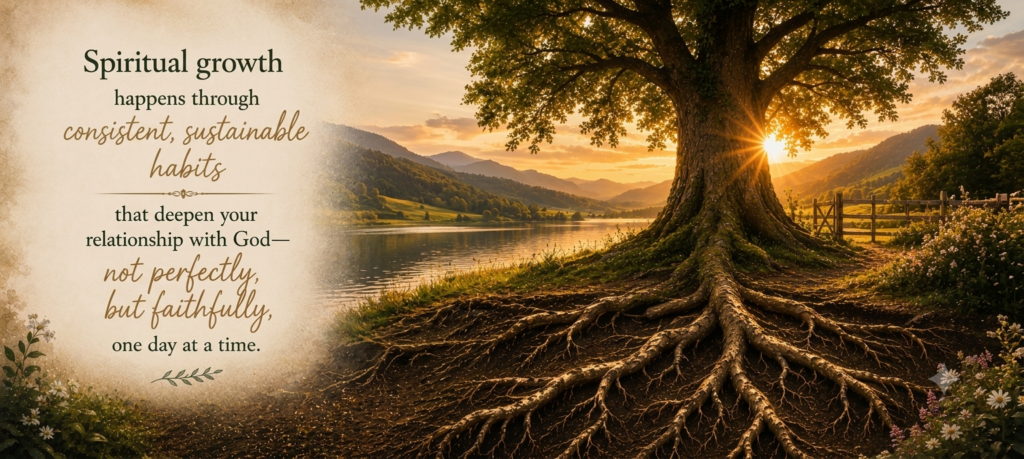
Spiritual growth happens through consistent, sustainable habits that deepen your relationship with God
— not perfectly, but faithfully, one day at a time.
Ponder This…
Which spiritual discipline is currently the strongest in your life? Which one needs the most attention?
What is one practical step you can take this week to strengthen your spiritual foundation?
Looking back over everything you have read in this book, what truth has impacted you the most?
What does the next chapter of your spiritual journey look like?
Step Into a Faith That Lasts
Father, thank You for walking with me through every page of this journey. Thank You for Your patience, Your grace, and Your faithfulness even in my inconsistency. Help me build a life that is strong enough to last — rooted in Your Word, shaped by Your presence, and expressed through a love for the people around me. I do not want a faith that fades. I want one that grows deeper every single year. Keep shaping me into who You created me to be. In Jesus’ name, amen.
What Comes Next
Congratulations on completing this journey through these foundations.
But I want you to hear this clearly — what you have read in these pages is not the finish line. It is the starting line.
A strong foundation does not exist so you can sit on it. It exists so you can build something on it. A life of faith. A life of purpose. A life that reflects the love, grace, and power of the God who saved you.
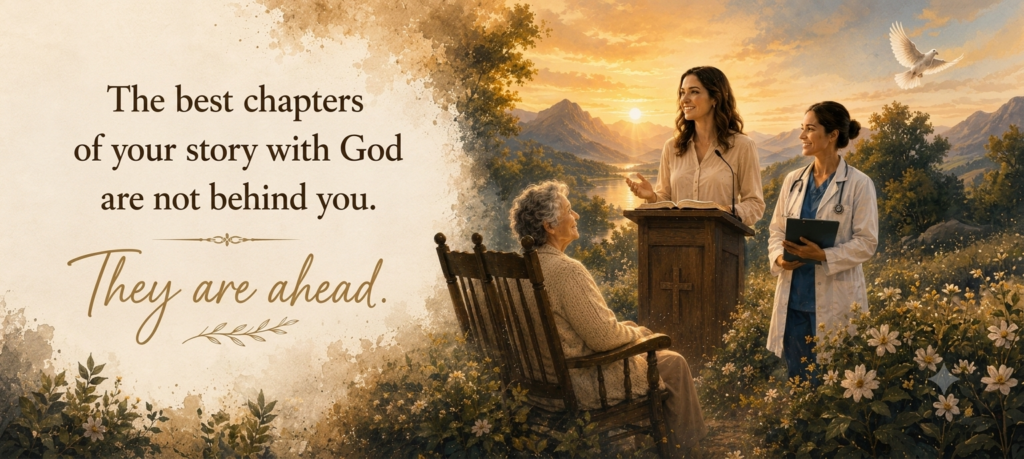
The best chapters of your story with God are not behind you.
They are ahead.
Keep going. Keep growing. Keep showing up — for God, for the people around you, and for the person He is shaping you to become.
Blessings!
Teri
If you’re ready to continue growing, I’d love to invite you to join us at LegacyTrainingInstitute.org. Our two-year certificate program is designed to help believers build strong biblical foundations and grow deeper in their relationship with Christ.


 English