
There was a season in my life when Communion had become routine for me.
The trays would be passed. I would take the small piece of bread and the tiny cup. I would bow my head, say a quick prayer, and move on with the service.
I was going through the motions.
Then one Sunday morning everything changed.
I was sitting in the pew carrying more weight than I knew how to handle. My heart was heavy. I had been struggling privately with things I had not told anyone. And when the Communion trays were passed that morning, something broke open inside me.
As I held that small piece of bread, I heard the words again — “This is My body which is given for you.”
For you.
Not for the church in general. Not for the spiritually put- together people sitting around me.
For me.
I sat there with tears running down my face, and it stopped being a ritual and became what it was always meant to be — an intimate, personal encounter with the love of Jesus Christ.
I want that for you.
Where Communion Began
To understand what Communion really means, we have to go back to the night it started. Jesus was gathered with His disciples for the Passover meal. For generations, God’s people had celebrated Passover as a remembrance of how God delivered Israel from slavery in Egypt. The Passover lamb was at the center of that story — a sacrifice that brought protection and deliverance.
But that night, Jesus revealed something His disciples had not yet fully understood.
Every Passover lamb had always been pointing to Him.
He was the ultimate sacrifice. The final Lamb. The one whose blood would not just cover sin temporarily but would remove it permanently.
During the meal, He took the bread. He gave thanks. He broke it. And He said words that would echo through every generation of believers after them:
“This is My body which is given for you; do this in remembrance of Me.” — Luke 22:19
Then He took the cup and said:
“This cup is the new covenant in My blood, which is poured out for you.” — Luke 22:20
In that single moment, the old became new. What had been a remembrance of Israel’s deliverance became a picture of humanity’s redemption. And He did not say, “Think about this once in a while.”
He said, “Do this in remembrance of Me.”
What the Bread Is Really Saying
Every time I receive Communion, I try to slow down at the bread.
This is not a cracker. This is not a symbol to rush through.
This is a reminder that the Son of God took on human flesh, walked among us, was beaten beyond recognition, and allowed His body to be broken — for me.
Isaiah wrote about this centuries before it happened:
“He was wounded for our transgressions, He was bruised for our iniquities; the chastisement for our peace was upon Him.” — Isaiah 53:5
When I hold that bread, I am confronted again with what Jesus willingly endured for me. He chose it.
He chose the cross. He chose the suffering. He chose to take what I deserved so that I could receive what He deserved.
The bread reminds me of His love. His obedience. His willingness to take my place.
I never want to rush past that.
What the Cup Is Really Saying
Then there is the cup.
“This cup is the new covenant in My blood.” Throughout Scripture, blood represented covenant — a binding agreement, a serious promise, an unbreakable bond.
Under the Old Covenant, animal sacrifices were offered repeatedly because they could only temporarily cover sin.Year after year, the same sacrifices, the same cycle.
But Jesus came as the final sacrifice. His blood did not just cover sin — it conquered it.
When I take the cup, I am reminded that I am living under a new covenant. A covenant not built on my performance or my track record or my ability to get everything right.
A covenant built on grace.
A covenant built on forgiveness.
A covenant built on the unshakeable promise that God made to us through His Son.
The cup reminds me that the debt has been paid. The case has been closed. The verdict has been declared.
I am free.
Preparing Your Heart Before You Come to the Table
One of the things I have learned over the years is that Communion is most powerful when we come to it prepared.
Paul wrote:
“Let a person examine himself, then, and so eat of the bread and drink of the cup.” — 1 Corinthians 11:28
Examining ourselves does not mean beating ourselves up or rehearsing every failure before we approach the table. It means coming honestly. Openly. With nothing hidden.
Here are a few simple ways I prepare my heart before Communion:
I slow down. I stop the rush of the service or the noise of my thoughts and I become intentionally present. I remember. I think specifically about what Jesus did — not in a general, theological way but in a personal way. He did this for me.
I release. If there is anything I am carrying — guilt, unforgiveness, worry, pride — I bring it to the table and leave it there.
I receive. I receive the grace that is already mine. Not because I earned it. Because He gave it.
What If I Feel Unworthy?
I want to speak directly to something, because I know this question lives in many hearts.
What if I feel too far gone to take Communion? What if my life is a mess right now? What if I have failed too many times? What if I am not sure I deserve to be at the table?
Here is the truth I want you to hear clearly:
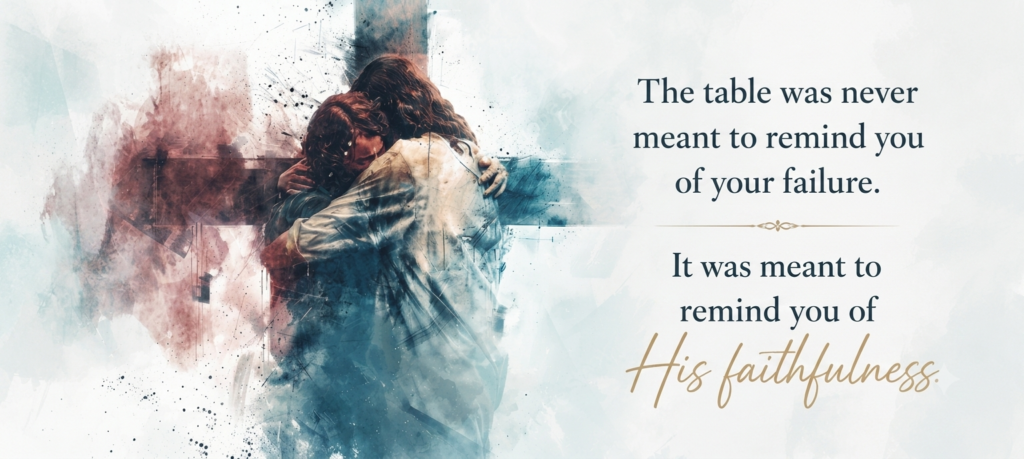
The table was set for broken people.
Jesus did not share His last supper with people who had it all together. He shared it with disciples who were about to deny Him, betray Him, and abandon Him. He knew what was coming. He broke the bread anyway. He passed the cup anyway.
Communion is not a reward for the spiritually successful.
It is a life line for the spiritually struggling.
The only requirement to come to the table is a heart that needs Jesus. And if that is you today — that is more than enough.
Come anyway.
Communion Looks Forward Too
There is one more thing about Communion that I do not want us to miss.
It does not only look backward to the cross. It also looks forward.
Paul wrote:
“For as often as you eat this bread and drink the cup, you proclaim the Lord’s death until He comes.” — 1 Corinthians 11:26
Every time we participate in Communion, we are not just remembering. We are declaring that this story is not over. That Jesus is coming back. That our hope is not buried in the past but alive in the future.
The same Jesus who gave His body and blood for us is coming again.
And one day, we will sit at a table with Him that makes every Communion we have ever shared look like a small preview of something far greater.
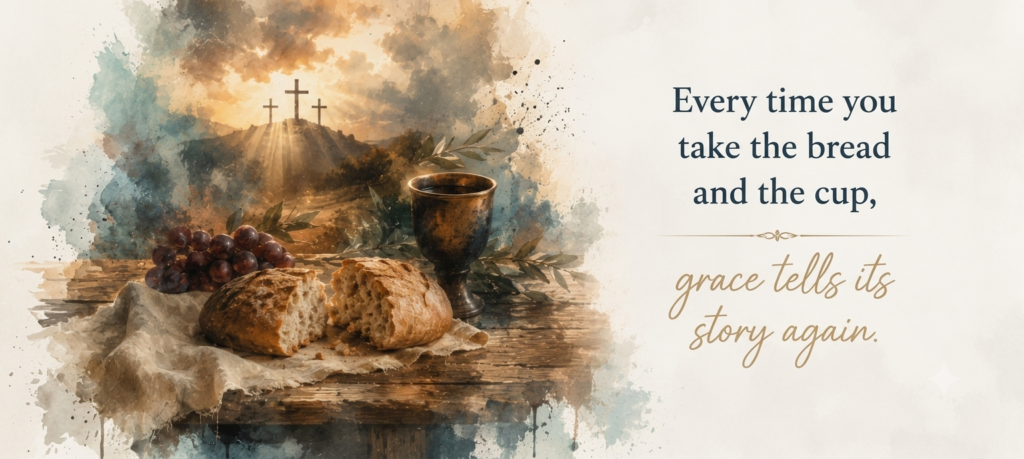
Until that day, we remember. We celebrate. We come to the table. And every time we do, we are reminded that grace still has a seat waiting for us.
The Foundation Truth
Communion is your step back to the cross — a sacred, personal moment to remember Christ’s sacrifice, receive His grace, and renew your commitment to the One who gave everything for you.
Ponder This…
When was the last time Communion truly moved you? What made it different?
Have you ever felt too unworthy to take Communion? How does today’s truth speak to that?
What would change if you came to the table slowly and intentionally every time?
Who in your life needs to know that there is a place for them at this table?
Step Back to the Table
Jesus, thank You for Your body that was broken and Your blood that was shed for me. Forgive me for the times I have rushed past this moment without truly receiving what You gave. Help me come to the table with a grateful and open heart. Remind me of what it cost. Remind me of what I received. And help me never lose the wonder of what You did for me on that cross. In Your name, amen.




 English